
India's largest carmaker, Maruti Suzuki India (MSIL), is focused on getting 50 per cent of its customers' car-financing transactions executed through its Smart Finance platform by next year. Shashank Srivastava, executive director-sales, MSIL, said this will help the company turn its website into a single-window channel through which customers can select their models, find dealers, and arrange financing. He said there is a likelihood that 100 per cent of its customers availing of financing will take it through Smart Finance. To date, the company has disbursed Rs 6,500-crore loans via Smart Finance to around 100,000 customers, accounting for 28 per cent of all finance-based car-purchase transactions for the company.

The company, however, said sales of the compact segment comprising Swift, Estilo, Ritz were down by 11.9 per cent to 13,882 in July this year as against 15,759 units last year.

Maruti, Hyundai & Mahindra together had 72.5% market share in year's first half.

The Union Cabinet on Wednesday approved a Rs 26,058 crore production linked incentive (PLI) scheme for auto, auto-components and drone industry to enhance India's manufacturing capabilities, Union Minister Anurag Thakur said on Wednesday. The PLI scheme will incentivize the emergence of advanced automotive technologies' global supply chain in India.

India has exported passenger vehicles worth $268 million to the US in three months ended June

The country's largest carmaker Maruti Suzuki India (MSI) aims to sell 4-6 lakh CNG units in the current fiscal year depending upon supply situation of essential components, as per a senior company official. The company sold about 2.3 lakh CNG units in 2021-22. MSI currently sells nine of its 15 models with CNG powertrain and is looking to drive in more models with such technology in the coming days.

The move is prompted by the disruption in the car usage pattern caused by the app-based ride-hailing companies such Ola and Uber

Country's largest carmaker Maruti Suzuki India (MSI) on Monday reported 8.7 per cent increase in total sales in February.

Tyre stocks have been on a tear over the past six months, with average returns exceeding 45 per cent. Except for Apollo Tyres, which has seen a slight correction in the last month and a half, limiting its gains to 16 per cent, listed peers such as MRF, CEAT Tyres (formerly Cavi Elettrici e Affini Torino), and JK Tyre & Industries have delivered returns exceeding 30 per cent during this period. Production-related constraints and sluggish demand in Europe, where sales are expected to remain flat, coupled with high valuations, have contributed to Apollo Tyres' underperformance. The tyre sector's gains can be attributed to robust growth trends driven by the replacement market, which constitutes more than two-thirds of sales.
Ford's compact SUV will challenge not only the entry-level utility vehicles but also the premium hatches and compact sedans.

M&M's profit before tax from the farm equipment segment rose 31% last year to Rs 2,562 cr

Maruti's results and the investor response indicate that quite a few stocks in the auto sector could be on the verge of a big bounce, says Devangshu Datta.

Tata Motors on Tuesday launched its second electric vehicle -- Tigor EV, catering to the personal segment in the domestic market, priced between Rs 11.99 lakh and Rs 13.14 lakh (ex-showroom). The model comes in three variants, priced at Rs 11.99 lakh, Rs 12.49 lakh and Rs 12.99 lakh. A dual tone top-end trim is tagged at Rs 13.14 lakh. The auto major has already achieved success with its first electric model, Nexon EV and now commences deliveries of Tigor EV from around 150 sales outlets in 70 cities across the country.

The economy segment of India's car market is unlikely to revive soon term as inflation and prices prompt buyers to defer purchases. The share of entry-level cars in the passenger vehicle market dropped to the lowest in seven years at the end of the Financial Year 2021-22 (FY22). A recovery in the segment will be largely driven by the overall economic growth, improvement in income levels, and easing of semiconductor shortage, say carmakers and analysts.
One reason for the upward revision in the forecast comes from the surprise growth of 9.45 per cent notched by the industry since the beginning of this year.
According to the figures released by the Society of Indian Automobile Manufacturers, motorcycle sales in the country during the month was down by 17.68 per cent at 4,25,089 units, against 5,16,410 units a year ago. Commercial vehicle sales during the month increased by 1.69 per cent to 45,059 units from 44,308 units for the year-ago period, SIAM said.

Hero MotoCorp, Honda Motorcycles, Scooters India, TVS, Honda India, Toyota Kirloskar Motor, Ford, Nissan, Ashok Leyland are all giving the Auto Expo a miss this time.


'With NPA under control, we should be able to post better profits.'
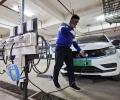
The government on Friday approved an electric-vehicle policy, under which duty concessions will be given to companies setting up manufacturing units in the country with a minimum investment of $500 million, a move aimed at attracting major global players like US-based Tesla. According to an official statement, the companies setting up manufacturing facilities for e-vehicles will be allowed to import a limited number of cars at lower customs duty. The policy seeks to promote India as a manufacturing destination for EVs and attract investment from reputed global EV manufacturers, it added.
286 dealers closed down in 18 months, 32,000 jobs impacted. Maharashtra leads with 84 closures, followed by Tamil Nadu and Delhi. The worst-hit is the passenger car segment.

A lot rides on this new vehicle for Renault, the seventh largest player in domestic passenger vehicle market, as its brand new SUV takes on Maruti Suzuki Brezza, Hyundai Creta and Ford EcoSport.

The company is banking on investments lined up for product development and other innovations.

If you are planning to buy an electric car in the near future, it would be highly advisable to wait for these upcoming electric SUVs.

Even as domestic passenger car sales declined 29.4 per cent between April and August this year, exports grew 6.5 per cent, partially cushioning the blow from slowing sales.
According to FADA, automobile retail trade and service industry comprises a network of 9,500 automobile dealers and their service stations engaged in sale, service/repair and spares of vehicles across segments, is an essential link in automotive business and a significant stakeholder.

Total sales of commercial vehicles were down by 5.59 per cent to 48,473 units from 51,344 units in the year-ago period, SIAM said.
Sales of recently launched Grand i10 and Xcent jump even as those of competing models drop in past two months.
Country's largest car maker draws nearly half of its sales from exchange programmes, rural focus.

Various factors, including robust demand in rural markets and good response to new models, helped in driving the sales.

Maruti is expected to post double-digit growth on product launches and good demand for entry-level cars.

The highest pay hikes for the current year are set to come from Maruti Suzuki and Hero Honda.

'While most companies were bullish before the second wave of double-digit sales growth in FY22, that may not be the case now.'

December is a month of high retail sales for cars, as companies and dealers push stocks to clear inventories
Price reduction by auto buyers leads to only a marginal rise in enquiry level.

While the share of diesel vehicles sales in the overall passenger car industry has already fallen sharply, sales of CNG vehicles have shown a compound annual growth rate of 15.5 per cent over the past five years.
The company sold 62,515 vehicles in December 2007 which includes 4,114 units of exports

Sales of vehicles across categories registered a growth of 3.75 per cent to 16,19,689 units in January against 15,61,130 units in the same month of 2013

With sentiment for the automotive (auto) sector turning positive, stocks of two-wheeler auto majors have been hitting their 52-week highs. Hero MotoCorp, Bajaj Auto, TVS Motor Company, and Eicher Motors recently reached their yearly highs on strong sales in the festival season and the expectation of faster growth rates ahead. Since the start of this month, listed two-wheeler majors have delivered returns in the 12-17 per cent range, compared to the 7 per cent gains for the S&P BSE Auto Index and 3 per cent for the benchmark S&P BSE Sensex.

'The decrease in the popularity of white cars and the rise in preference for darker colours like black, grey, and blue over the past three years reflect changing consumer attitudes.'
